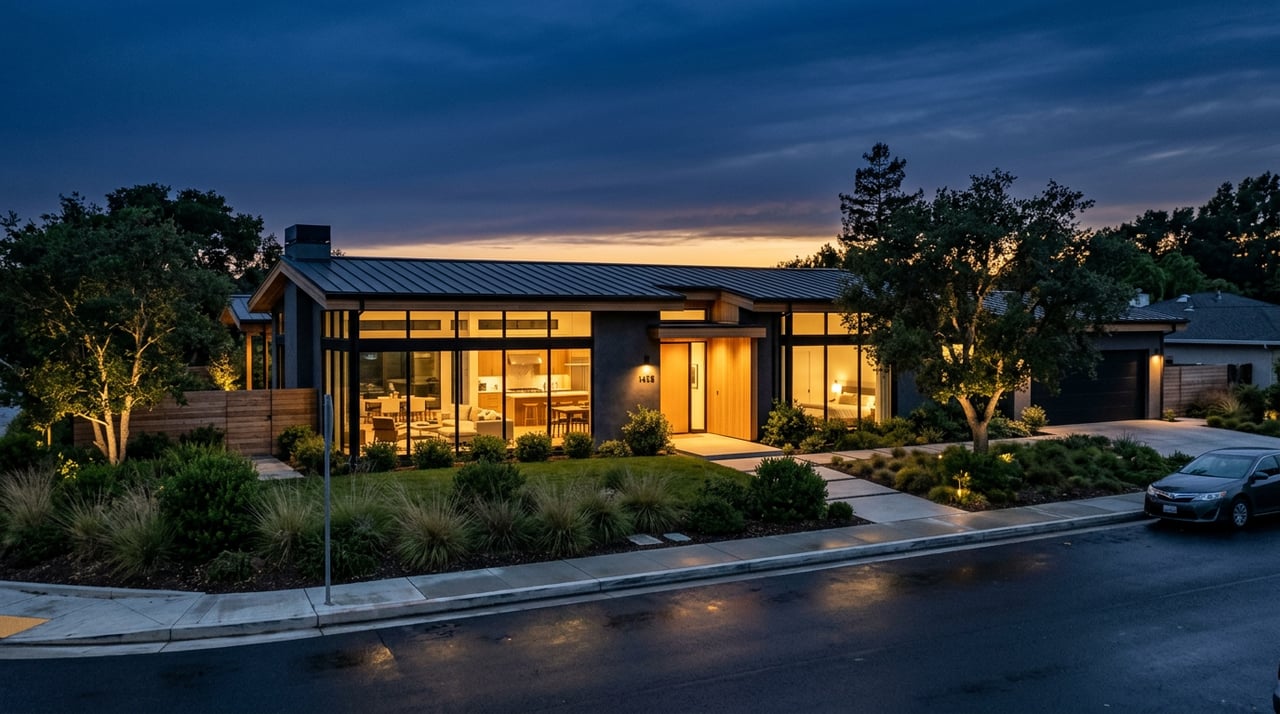
Frontwave Arena Opened Two Years Ago in Oceanside. Home Prices Next Door Still Haven't Moved.
September 17, 2026
September 17, 2026
Drive up Rancho Del Oro Drive on a game night and you will find valet lines, a plaza full of jerseys, and roughly 7,500 people converging on a building that did not exist before 2024. Frontwave Arena, the $85 million venue built on the old sand-mining flats of El Corazon, is now the home ice, court, and turf for the San Diego Sockers and the NBA G League's San Diego Clippers, plus a rotating calendar of concerts and events that the city projects at close to 160 dates a year. It is, by any normal reading of how neighborhoods change, the kind of investment that should show up in the comps a few blocks away.
It has not. Two years after the arena opened its doors in September 2024, the ZIP code that contains it, 92057, is still pricing like a plain inland tract. As of May 2026, the median home price there sat at $818,000, essentially in line with Oceanside's citywide typical home value of about $816,000 that Zillow reported the same summer. Meanwhile South Oceanside, five miles closer to the pier and nowhere near a professional sports tenant, closed homes at a median of roughly $1.5 million over the three months ending in June 2026. The arena is real. The premium isn't, at least not yet. That gap is the story, and it tells a comparison-shopping buyer something the median alone won't.
Here is the comparison stripped down to what each area actually offers and what it currently costs:
| Area | What's there | Recent median |
|---|---|---|
| 92054 / South Oceanside, west of I-5 | Walkable coastal blocks, the pier, the harbor | Roughly $1.5M, three months ending June 2026 |
| 92057 / Rancho Del Oro, Arrowood, El Corazon | Frontwave Arena, an Olympic-scale aquatic center, a 1,950-acre master-planned community | About $818,000 as of May 2026 |
| 92058 / Central Oceanside | The city's most accessible entry-level tier | Below 92057 on price per square foot in every tracker that breaks Oceanside out by ZIP |
That $700,000-plus gap between 92057 and the coast is not new. Rancho Del Oro has always priced below the water, and nobody buying five miles inland expects beachfront numbers. What's notable is that the gap barely moved even after the city dropped a professional sports venue, an aquatic complex serving 1,100 simultaneous users, and a mixed-use master plan into the same footprint. In most markets, a venue of that scale becomes a talking point in listing descriptions within a year or two. In Rancho Del Oro, it hasn't repriced anything.
It helps to separate what El Corazon has actually delivered from what's still promised.
Delivered: the arena itself, which held its first event in September 2024 and now anchors a calendar of Sockers games, Clippers G League games, and concerts. Also delivered: the aquatic complex, with its 56-meter competition pool and 25-meter instructional pool, the first new swimming facility Oceanside has built since the 1950s.
Still pending, as of the city's own project pages: the mixed-use residential parcel the El Corazon Specific Plan sets aside next to the arena site, and Park Site 1, a planned 17-acre public park at the corner of Rancho Del Oro Drive and El Corazon Drive. The city approved a design agreement for that park in February 2022 and opened public meetings later that year, but its own planning page lists construction as expected to begin in 2026, meaning the piece of El Corazon most likely to function like a neighborhood amenity, rather than an event destination, is only now approaching groundbreaking.
That distinction matters for pricing. A stadium that pulls in visitors for 160 nights a year is an economic asset for the city. A finished park and a completed residential village next door are what typically move a buyer's sense of a neighborhood's everyday character, and those pieces are the ones still on paper.
Rancho Del Oro has a documented history of exactly this kind of mismatch between headline investment and street-level follow-through, and it is worth knowing before you assume the gap closes on its own.
In the 1980s, the developer installed roughly 635 decorative metal streetlights across the community, a signature look for the Villages of Rancho Del Oro. By 2010 the bolts holding them to their bases had rusted through, and the city began pulling them down for safety. What followed was a multi-year standoff: the homeowners association sued, arguing the city should pay to replace them, and lost. In February 2013, a Vista Superior Court judge ruled the city had no obligation to fund the replacements. The city later offered to split the roughly $2.2 million cost, agreeing to cover about $830,250 in standard streetlight expense while asking the HOA to fund the remaining $648,000 in specialty upgrades. Residents were then asked to approve a special tax assessment, about $530 per unit over five years, to cover their share. They voted it down, and in March 2016 the Oceanside City Council formally abandoned the assessment process. The streets stayed dark rather than raise everyone's taxes.
That episode closed a decade ago and isn't a live dispute today. But it's a useful data point on how this specific master-planned community handles the space between big civic investment and basic residential upkeep: slowly, and not always in the direction homeowners expect. A buyer weighing whether El Corazon's amenities will eventually show up in 92057's comps should know that this neighborhood has a track record of civic promises outrunning the infrastructure vote, and that the timeline can run in years, not quarters.
For a buyer stacking 92057 against the coastal ZIPs, the arena and the aquatic center are already yours to use regardless of when the rest of El Corazon finishes. What you're actually pricing in today is:
If you're comparing this to South Oceanside or the coastal corridor, the honest framing is that you're not buying into a neighborhood that has already repriced around its new venue. You're buying into one where that repricing, if it happens the way it typically does elsewhere, hasn't shown up in the comps yet. That can be an opening for a buyer who wants more house and more amenity access for the money today. It can also mean waiting on two specific milestones, the Park Site 1 groundbreaking and the mixed-use residential parcel breaking ground, before betting on appreciation tied to the arena rather than to the broader Oceanside market.
Does living near Frontwave Arena mean event-night traffic on my street? Parking for events routes through dedicated lots off Rancho Del Oro Drive, with additional bus service from North County Transit District's Rancho Del Oro station. Ask any listing agent for the specific street's distance from those routes rather than assuming inland location means quiet nights.
Is the Rancho Del Oro HOA still dealing with infrastructure disputes? The streetlight fight that defined the community through the early 2010s was formally closed in 2016. Current HOA dues and reserve studies reflect that resolution, but every village within the larger master plan runs its own association, so terms vary by subdivision.
Will 92057 prices catch up to the coast once El Corazon is finished? Nobody can promise that, and nothing in the city's own project pages guarantees it. What the pages do confirm is a 2026 target for Park Site 1 construction and a still-undeveloped mixed-use parcel, both of which are the pieces most likely to change how the neighborhood reads to a buyer once they're built.
If you're weighing Rancho Del Oro against a coastal Oceanside ZIP, or trying to figure out what a specific address is actually worth against these numbers, the Jim Bottrell Team can walk you through the current data street by street. Start with a free home valuation or browse the Oceanside neighborhood guide for more on how the city's different corridors are actually pricing right now.
Stay up to date on the latest real estate trends.


We pride ourselves in providing personalized solutions that bring our clients closer to their dream properties and enhance their long-term wealth. Contact us today to find out how we can be of assistance to you!